Fields of flax, to harvest, spin and weave. The Junction, Ballinamore
Fields of flax, to harvest, spin and weave
Fiona Murphy, 2026
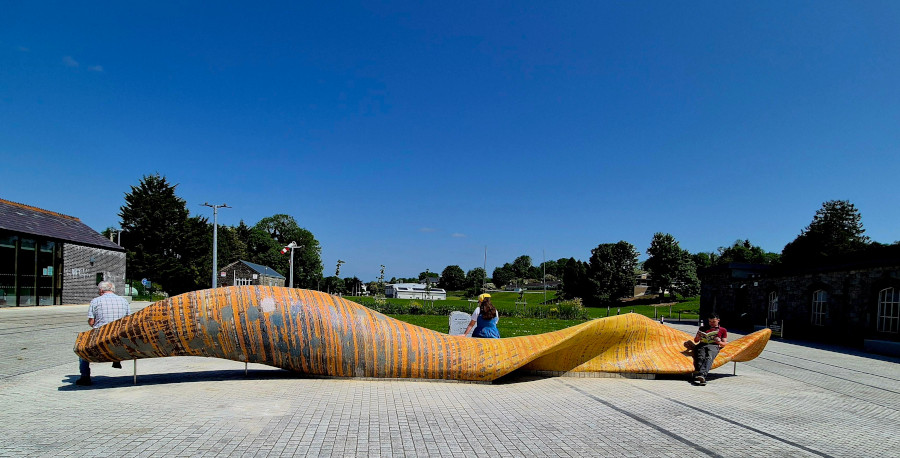
Fields of flax, to harvest, spin and weave draws on the history of flax farming in Ballinamore, where unbleached linen made in homes was once sold at markets here, and echoed in placenames like Scutch Bridge. The sculpture traces the flax plant from blue flower through harvest browns and ochres into a woven linen pattern, reflecting both process and material.
Developed through historical research and community workshops, its palette responds to the surrounding red and yellow brick architecture and invites touch and use, encouraging visitors to sit and engage with its textured mosaic surface.
Murphy’s response to the artist's brief for this work centred on the significant, but largely forgotten, tradition of flax growing and processing in Leitrim, which she discovered through research at the library in Ballinamore. The starting point for this was an archival document available on microfiche entitled “A list of persons to whom premiums for growing flax-seed in the year 1796 have been adjudged”. This survey lists over one thousand households in Leitrim that received a spinning wheel as a grant to promote flax growing in the hinterland of Ballinamore. It was a family industry with the wives and daughters spinning and the sons and husbands weaving. Historical records show evidence of flax growing in many areas including Carrigallen, Oughteragh, Fenagh and Drumreilly.
“This project is about weaving together the threads of history, place, and community, I want the sculpture to reflect Ballinamore’s heritage in a way that feels alive - something people can sit on, touch, and be part of. Working with the Crafty Bunch and the Transition Year Students, has contributed in shaping not just the details of the piece, but its spirit.” - Fiona Murphy, artist
According to the artist the inspiration for the project was the connections between farming the flax, the extracting of flax fibre, the spinning of linen thread, and the weaving of linen. Ballinamore is steeped in this history, and its significance in early farming-led industries is important. With transport systems provided by the canal and a historical railway, Ballinamore was an important focus for the flax that was grown in the region.
Community collaboration is central to the artwork’s creation, and as part of this approach, Fiona delivered a series of workshops with Transition Year students at Ballinamore Community School and is working with a local craft group – The Crafty Bunch. The craft group is undertaking a companion project as part of the Creative Ireland programme, building on social engagement and the participatory ethos at the heart of the artist’s design and concept.
Rooted in Ballinamore’s flax growing and linenmaking heritage, Meath artist Fiona Murphy’s site-specific sculpture at The Junction takes the form of an undulating, fabric-like seating structure designed to animate the space and to entice and encourage greater use of The Junction for all sorts of community uses.
The community project led the group to Mallon Linen in Magherafelt where Helen and Charlie Mallon have been reviving the tradition, rescuing and restoring flax processing equipment and running workshops in how to grow and process the crop. During the workshops, Helen and Charlie discussed the processes of growing flaxseed varieties, seed rates, soil types, weed control, and harvesting. The participants enjoyed the hands-on experience, which involved exploring the skills involved in hackling, heckling, and extracting the fibre from the harvested and dried flax stems. The group members also witnessed the innovative applications of flax in Magherafelt from innovative resinbased replacements for plastic in craft and household items to developing new sustainable materials at Ulster University, Belfast. One community member remarked, “The hands-on experience was incredibly rewarding. It gave us a much deeper understanding of the skills and techniques involved in flax processing.” It was decided during the workshop to grow flax at The Junction in Ballinamore as part of the project. A section of the grass area was selected and prepared by members of the local community employment programme under the guidance of Gerry Keegan. By mid-July, the first flax flowers appeared in Ballinamore 200 years since flax last grew in Leitrim for the flax-making Industry.
The site-specific sculpture that Fiona has created for The Junction is based on a piece of linen fabric. The piece is clad in a vibrant and detailed mosaic which reflects the grid-work of a weave. The design for the mosaic has been kept simple and is based on the pattern of linen and the colours of the flax flower and golden flax seed heads. The sculpture’s organic form, evoking the twists and folds of linen fabric, invites visitors to rest, explore, and interact. At one end, the motif represents a spray of blue flowers in a meadow of flax. The transition of colour is gradual; the simplicity of the pattern keeping a focus on the form itself. The sculpture can be used as informal seating with the intention to create a social space and focal point in the courtyard of The Junction.
The location of the sculpture at The Junction is also important. It was here a monthly linen market was established in Ballinamore more in 1760. In his Book, ‘The History of the Town and Parish of Ballinamore, Co. Leitrim, author Fr. Dan Gallogly describes the market and being quite successful, with premiums over £20 paid to producers.
Fiona hopes that the project and the sculpture will provide people with a glimpse into the past and a focal point in the town that links with a rich cultural heritage. “Who knows what the seeds of this project may grow; perhaps it will be picked up by local farmers interested in sustainable agriculture or local designers may be inspired by it. In an era of fast fashion, it’s in our heritage that we’ll find sustainable alternatives to mass-produced imported textiles.”
She concluded by stating the importance for her of making work that referenced farming traditions, the family, and the local skills involved in what was a whole-family and household industry where the skills and traditions, although in different forms, are still rich and alive around Ballinamore.
“We are thrilled to see Fiona’s concept and vision take shape. Her proposal stood out for its sensitivity to place, respect for local traditions, and commitment to working hand-in-hand with the community. The colours that Fiona has incorporated in the piece cleverly connect the buildings at The Junction, with the sculpture transitioning from a yellow straw colour beside the red brick of one building to the blue flax flowers towards the limestone on the other side. All in all, the sculpture really animates the space and will hopefully entice and encourage greater use of The Junction for all sorts of community uses, further building on Ballinamore’s thriving cultural landscape.” - Philip Delamere, Arts Officer.
This commission is part of Leitrim County Council’s Public Art Programme, funded by the Department of Housing, Local Government and Heritage under the Per Cent for Art Scheme. This funding enables the Council to commission high quality and ambitious contemporary art for the public to experience and enjoy in everyday settings. The Council extends its gratitude and appreciation to all stakeholders and collaborators: The Junction - Leitrim School of Art, Ballina more Youth Action Project, and The Hub; Ballinamore Community School, the Crafty Bunch, Southwest Leitrim Rural Social Scheme, Ballinamore Library, Mallon Linen and Ballinamore community for their continued support and collaboration.